![Write with [M]arie [E]vans](https://writewithme.blog/wp-content/uploads/2023/07/black-white-minimalist-aesthetic-initials-font-logo-edited.png)
Most authors will swear there is no magic query letter. The querying process is half happenstance-luck and half professional finagling. While both can be true, it’s up to us as writers and authors to do what we can to increase our odds of achieving that publishing dream by understanding both sides of the ever-changing process.
The Happenstance Bit
Querying your manuscript is a flawed, incredibly human, process.
Clicking “send” on that email or submission form can, at times, feel like sending your query out into the void. There may be an automated message to assure you it’s been received and when you can expect to hear back from the agent, and…there may not. Some of the weeks can pass. Even all of the weeks PLUS some. And a response may never come. Or good news can come far after you expected a response.
That’s… the happenstance bit.
Sometimes, it’s not about how good or bad your query is written. Sometimes, it comes down to luck. Many agents report receiving hundreds of query letters a week. In never receiving a response (rejection or acceptance), it can be assumed that there is a possibility your query was lost in the avalanche. The difference between no response and the response of your wildest dreams can come down to just a bit of good luck, good timing, good mood.
It’s important to keep a spreadsheet while querying for that reason. Mine looks a little something like this:

Each box is important but the “Response Given” and “Notes” are the most important when it comes to gauging your progress with agents and possible issues with your query. In a good state, you should see your responses go from possibly no response -> generic copy-paste response -> a personalized response (even if it’s a rejection letter) -> requesting more pages or the full manuscript.
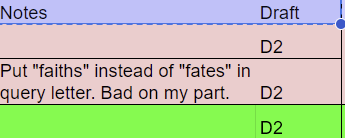
If you see the responses stay about the same, meaning that progression isn’t happening, you may need to take a look at your query letter. Which brings me to the “Notes” box. Here is where I like to put what may have gone wrong or gone well. Below, I noted a misspelling I found in my query which can be a huge turnoff to some agents and eventually led to a generic rejection letter from that agent.
If you are getting to the stage where agents are requesting the full manuscript, but no one is looking to represent you, that could be a sign there is an issue within the manuscript.
Becoming a Professional Finagler
As writers, we can control a lot in our works, but not much else when it comes to the querying process. We can’t control what mood an agent may be in or how many others our letter may fall behind in the inbox. But we can control how we query.
A template that I find works well for me (and for what Agents look to find in query letters) is the following:
Dear [Agent],
I am [Author name], author of [Book title]. Your profile mentioned a want for [add personalization to show you researched the agent and understand how your book fits in with their wants]1. At [novel word count] words, [Book title] is a novel that [explain where this book fits genre-wise. Does it blend noir with horror? etc.)2.
Comparable to recent titles such as [add comparable book titles]3. [Add a line here to explain themes your book touches on, and which themes may be unique to the ones you mentioned in your comp titles]4.
[Here is where you want to put the synopsis. Think of who, what, when, where, why. This is the paragraph for the back jacket pitch].5
This novel is the first of others within the same genre currently in progress.
As stated in your guidelines, I’ve included what I consider to be equal to [page amount]6. Thank you for considering [Book title].
Thank you for your time and consideration,
[Author name]
- Just like applying for a job or writing a personal statement to a university, Agents too want to know you have put thought into why you’re choosing to query them specifically. No need to schmooze them, just let them know you have done your due diligence. ↩︎
- This first paragraph is laying the groundwork. It’s explaining who you are, why you’re querying that specific Agent, and how your novel fits into who or what they like to represent. You can choose to expand this paragraph by adding in more biographical information. I decided to forgo that information, since I don’t have anything to include that I feel would add to my esteem. ↩︎
- Comparable titles should be recent. Within 5 years old is preferable to show you have knowledge of the marketplace. Do not choose big name titles. Don’t go with Stephen King. Go with Cassandra Khaw instead. Go with reasonably selling titles. One of the biggest query mistakes is to compare your book to a household name or a branded author. ↩︎
- This is called a Unique Value Proposition (UVP). This is where you show your understanding of the market (what your book is similar to) before explaining how your book stands apart (how your title is unique, even if just slightly so). ↩︎
- Keep the synopsis down to about a paragraph. Query letters shouldn’t be over a single double-spaced page, just like you would a resume. ↩︎
- Here, again, you’re showing the Agent you’ve done your research. The page number mentioned is the number of pages they request you send with your query letter (as these vary widely between agents). ↩︎
You can think of this paragraph layout as:
1: An introduction of you and the Agent.
2: A show case of your market knowledge and UVP.
3: Synopsis of book.
4: A promise of a prolific writer and a polite close.
With this template you hit the nail on the head when it comes to including most of what Agents are looking to know about you and your novel within your query letter. Please note again, that some Agents are stingy when it comes to finding spelling errors in query letters. Ensure you copyedit the letter thoroughly before sending to anyone or…it can be the reason behind your rejection.
Now, go attack the day! And best of luck on your publishing journey.


Leave a Reply